Strawberry Hill Electronics · Kansas City, Kansas
RESO‑1
A pocket analog synthesizer. One discrete sawtooth oscillator, a two‑pole resonant filter, eight brass‑contact keys, and 22.4 hours on two AA batteries, measured.1
- Voice
- 1 analog VCO. No wavetable on this board, ever.
- Filter
- 2‑pole lowpass. Self‑oscillates above 7, on purpose.
- Sequencer
- 16 steps. Pattern swaps land on the downbeat.
1. Speaker on, backlight at full, eleven runs. Worst case 21.9 hours, and I am still upset about it. · Marisa
$189 first run of 500 · ships March 2027
deej the white keys up there? they work. tap one! or press A thru K
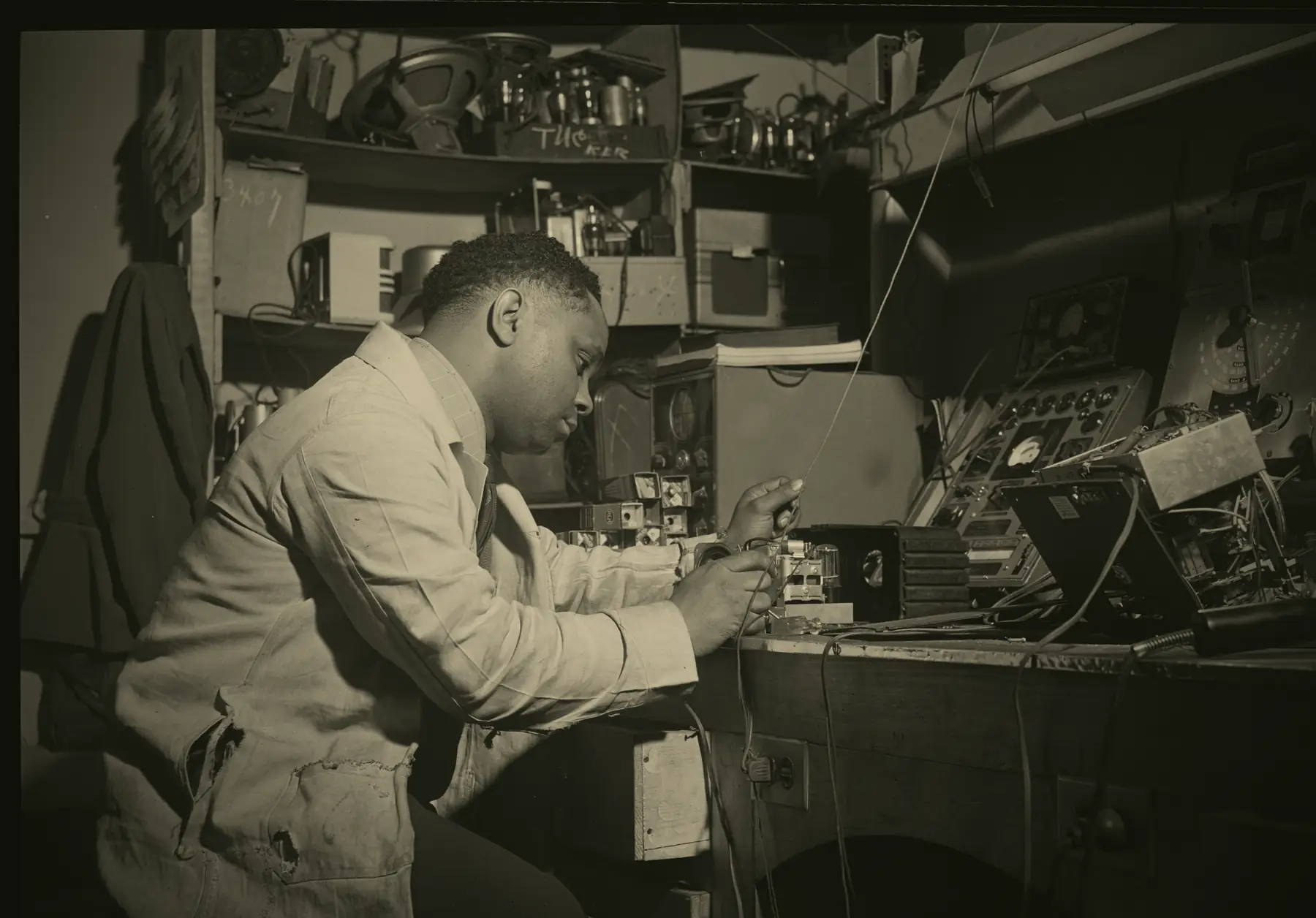
00 · THE BENCH · MARISA
One bench, two people, 500 units.
Every RESO‑1 is stuffed, reflowed, tuned by ear and signed off in a rented back room on Ann Avenue in Kansas City, Kansas. The wall behind the bench is painted warm near‑black because I cannot read an oscilloscope through glare.2
We do not start a run until every part for it is on the shelf, which is why the date on this page is March 2027 and not a season. A first run of 500 is the number two people can tune without lying to you about the schedule.
2. Behr N520‑7, two coats, roller. Deej lobbied for a mural. There is no mural.
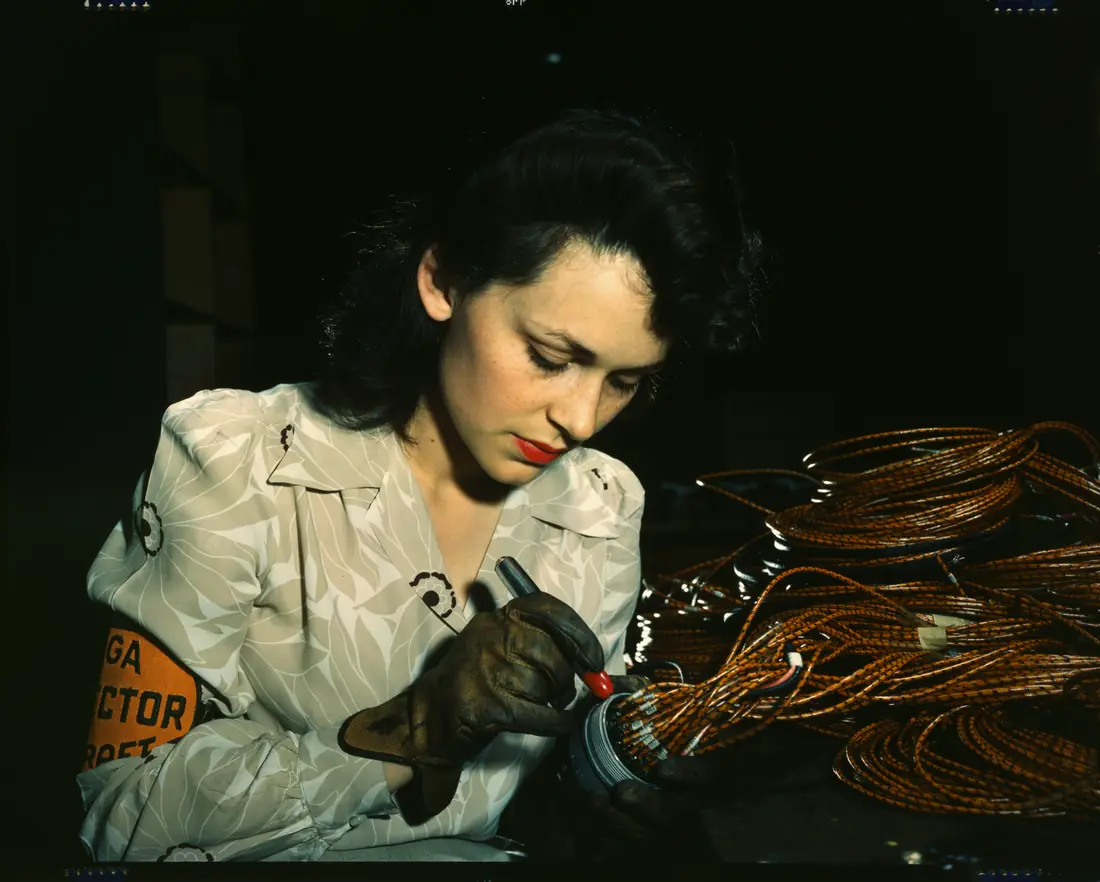
deej looms like this are why the harness inside a reso is hand‑laced. marisa laces, i hold the light. tkk. tkk. tkk
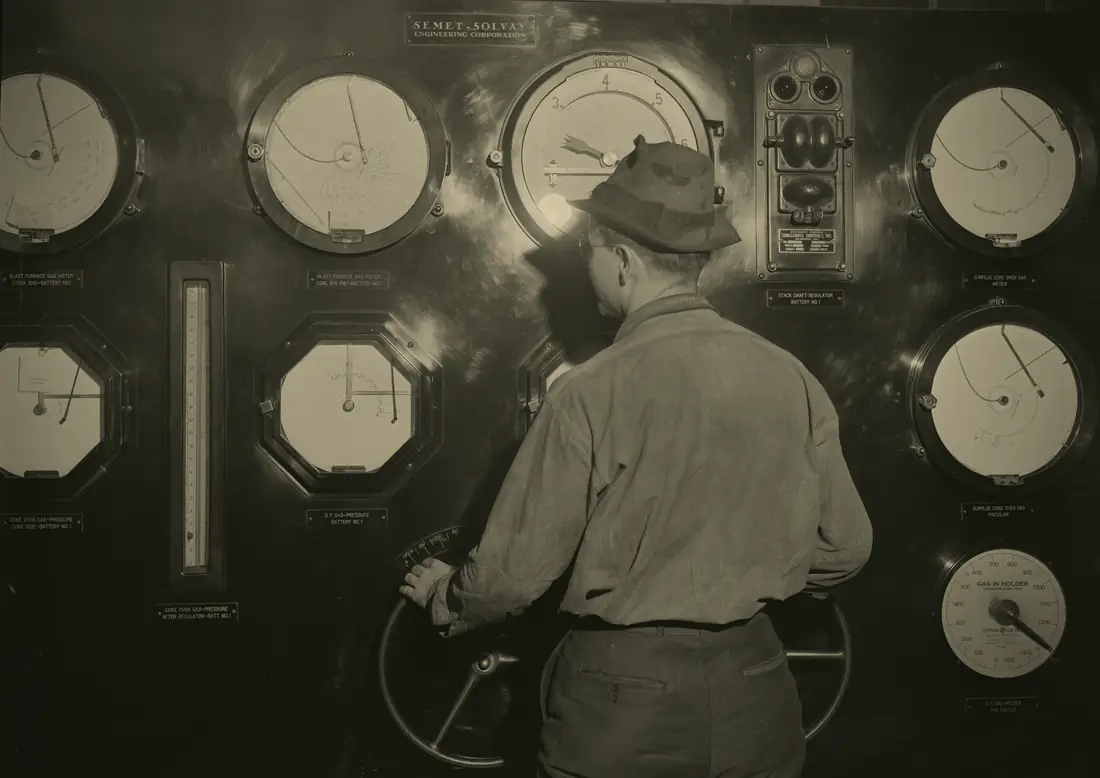
Backdrop and plate are archival, not our bench: Jack Delano, Chicago, April 1942 (LC‑USW3‑001477‑D) and David Bransby, Burbank, June 1942 (LC‑DIG‑fsac‑1a34456), Library of Congress FSA/OWI Collection. Public domain.
01 · THE VOICE · MARISA
One oscillator, built from parts you can point at.
The core is a discrete sawtooth with hand‑matched transistors. Nothing in the signal path is a lookup table. It drifts a few cents while it warms up, under 4 by minute three,3 then settles into the tuning that old monosynths charge four figures for.
The filter is a two‑pole resonant lowpass. Above 7 on the RES knob it self‑oscillates into a clean sine you can play as a second voice. That is a feature with a slope, not a defect with an excuse.
3. Cold start at 20°C. In January on the bench it takes four minutes, and I have the log.
02 · THE SEQUENCER · MARISA
Sixteen steps, on the downbeat, every time.
Punch steps in while it runs. Pattern changes queue and land on the downbeat, because a swap that lands whenever the processor is ready is not a swap, it is an accident. Swing runs 50 to 70 percent and ships set to 54.4
Sync in and out are 3.5mm pulse, the same standard the Volcas and Pocket Operators speak, so it sits on a crowded table without an adapter or an argument.
4. Deej set the default and hid the jumper. His position is that 50 percent feels like marching. I have stopped contesting it.
03 · THE POCKET PART · MARISA
240 grams. Two AA batteries. 22.4 hours.
That runtime was measured with the sequencer running, the speaker on, and the backlight at full, because a spec you can only reach with headphones and the screen off is not a spec.5 Alkalines from the gas station work. So do rechargeables, and so does USB‑C.
The chassis is one piece of glass‑filled nylon over brass key contacts. Unit 7 has been dropped 1.2 meters onto concrete twice, from my own bench, and still holds tune. Every unit is tuned by ear on Ann Avenue before it ships, and the test sheet inside the box is signed by whoever tuned yours.
5. Eleven runs, five battery brands. Worst case 21.9 hours, best 23.1. We print the conservative number.
Go on, play it.
deej these eight keys run a browser model of the real voice. same saw, same filter curve, same envelope. the hardware sounds better because it's electricity, not arithmetic. click, tap, or press A thru K. you can't break it with your ears.
Marisa's note: the model runs at your browser's sample rate. The hardware does not have one.
Four patches off the bench.
deej synthesized live in your browser, nothing prerecorded. the names are where i was standing.
Archival, not our bench: Arthur S. Siegel, October 1942, Library of Congress FSA/OWI Collection, LC‑USW3‑009455‑C. Public domain.
Specs, with units.
Archival, not our bench: Arthur S. Siegel, November 1942, Library of Congress FSA/OWI Collection, LC‑USW3‑011193‑C. Public domain.
- Voice
- 1 analog VCO, discrete sawtooth core, square sub‑octave divided from it
- Filter
- 2‑pole resonant lowpass, self‑oscillation above 7 on RES
- Envelope
- One knob, decay‑shaped, 20 ms to 4 s
- Sequencer
- 16 steps, 8 patterns, swing 50 to 70 percent
- Keys
- 8, brass contact, C major pentatonic by default, remappable
- Connections
- Line out, headphone, sync in, sync out, all 3.5 mm
- Speaker
- 28 mm, 84 dB SPL at 30 cm6
- Power
- 2× AA, 22.4 h measured, or USB‑C
- Size
- 148 × 82 × 22 mm, 240 g with batteries
- Made
- Assembled and tuned in Kansas City, Kansas
- Warranty
- Two years. Repairs happen at the bench that built it.
6. Measured in the stairwell, which is our quietest room. Deej describes this figure as "louder than that."
First run: 500 units. Ships March 2027.
$189, with $40 down to hold a place and the balance charged when your unit passes the bench. If the date slips, the email you receive will contain the actual reason, with a part number in it.
Questions first? Call or text (913) 555‑0152, weekdays 9 to 5 Central. I answer Tuesdays and Thursdays. Deej has the other days, and I apologize in advance.
deej unit numbers go out in order. 001 went to marisa's mom. she uses it as a doorstop but it's tuned